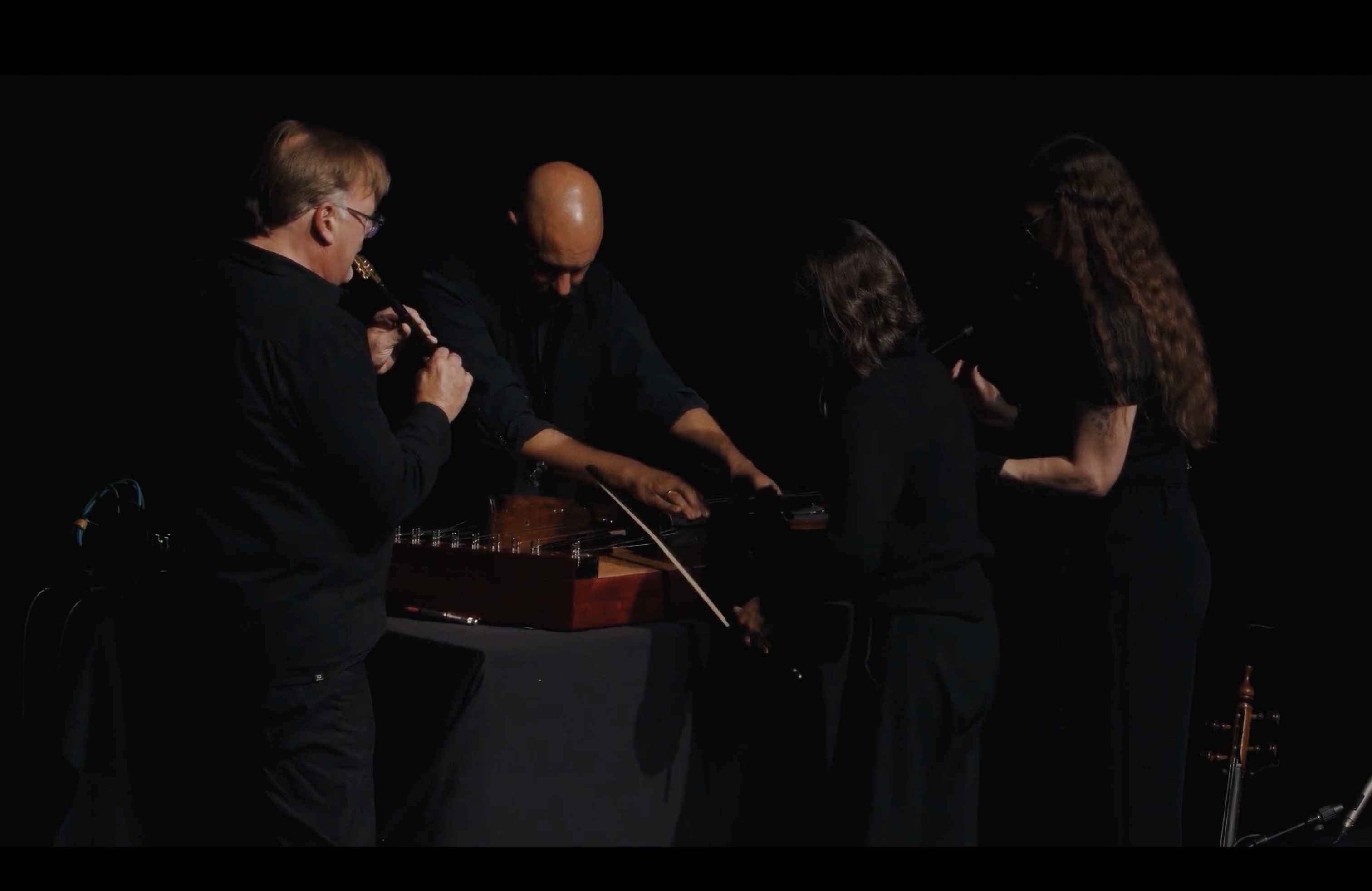
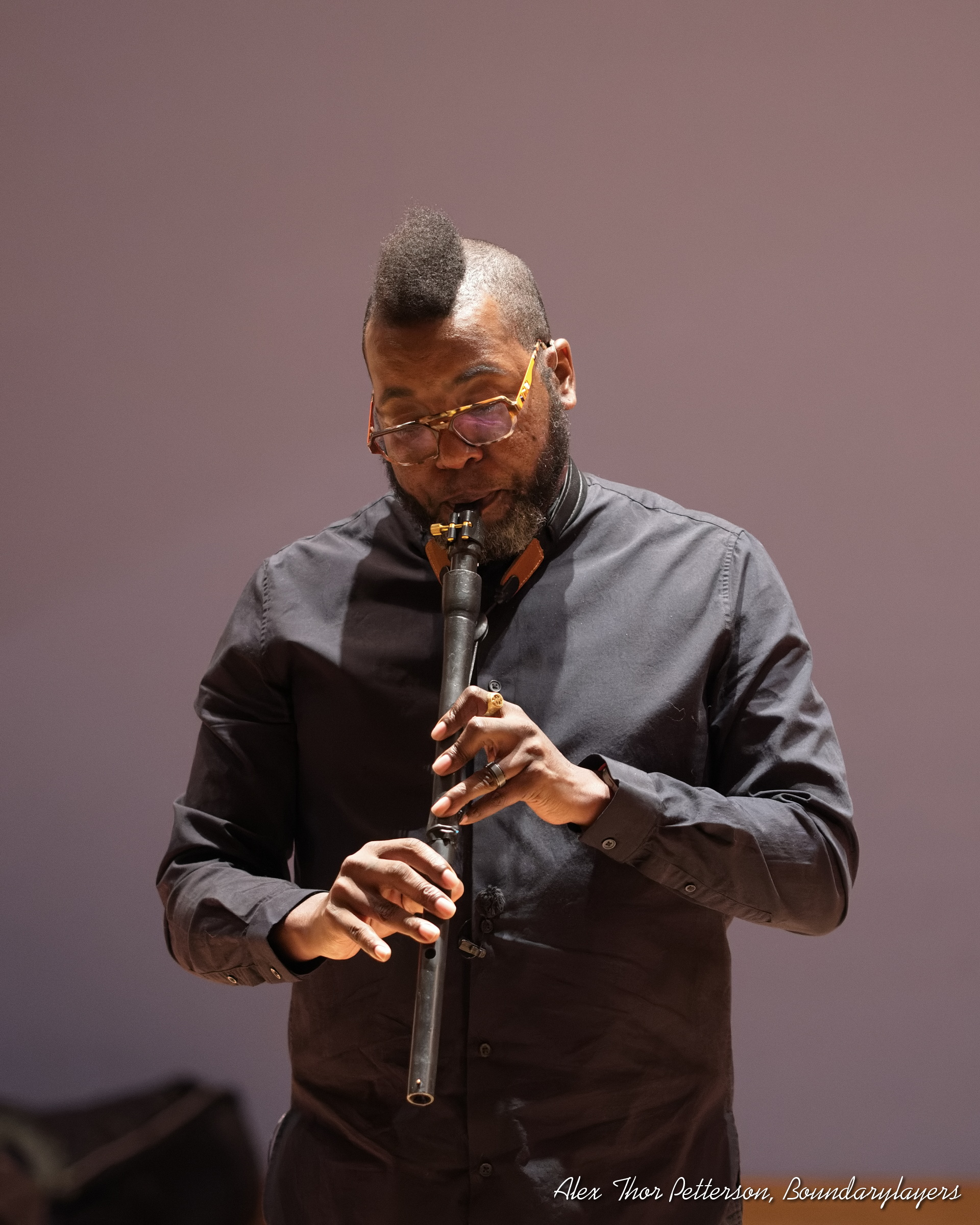
Resonant Transmutations consists of two long-form pieces for instruments crafted from decommissioned rifles by sculptor Pedram Baldari. Both pieces were composed by Matthew Rahaim, featuring throughcomposed parts and open forms that invite improvisation from a creative ensemble. The musicians use these transmuted weapons to sound out vulnerability, resonance, and tenderness, moving through the Indo-Iranian language family from Kurdish through a Persianate register of Urdu poetry to vernacular Hindi, drawing on poetic resources from Faiz Ahmad Faiz and Samuel R. Delany.
Hearing these instruments played tenderly offers a vivid image of a future where there is no need for weapons or armor, where even guns have been transmuted into offerings of beauty. But in these pieces, such a future is made, not given. The pieces equally embrace struggle, vulnerability, improvisation, and uncertainty. Even in the hands of a master artisan, gunmetal is heavy, brittle, not optimized for ergonomics or resonant tone. The musicians, composer, and sculptor all work patiently with these technical limitations, striving for beauty even while holding space for the history that haunts these instruments. This striving is an essential part of the process.
I. Heart-Arsenal
Heart-Arsenal retraces the musical path of Samuel R. Delany's Afrofuturist novel The Einstein Intersection. The novel follows the adventures of Lobey, an Orpheus figure who plays a machete-flute, a weapon and instrument akin to the barrel-flutes used here. Lobey undertakes an Orphic quest in a post-human Earth for Friza, a Eurydice figure. The piece begins with a tender solo lamentation on the lowest barrel flute, then builds through six movements tracing an emotional journey through grief, hope, illusion, and harsh reality, exploring how music functions in turn as enchantment and weapon, deception and revelation. The extended barrel flute techniques move between throughcomposed sections and spontaneous improvisation, recreating Lobey's musical sorcery: the gift of polyphony, clairaudience, and profound vulnerability. The performers coax sweet melodies and soulful moans from the barrel-flutes, intertwining breath, building interlocking grooves, inviting the audience into a world of tenderness hidden inside gunmetal.
The word arsenal derives from the Arabic dar as-sina'a (دارالصناعة), meaning "workshop" or literally "house of craft," referring especially to metalworking and textile work.
- I.1 — Death is Rhythm Suspendedsolitary lamentation for a love passed away
- I.2 — Won't You Come Home?a remembered tune hymns out devotional longing
- I.3 — The Calla call toward listening and mutual vulnerability
- I.4 — Glittering & Jumping Against Each Otherdiscovering and exploring polyphony
- I.5 — The Cruxdescending into the underworld, confronting illusion
- I.6 — Death, Suspendedresonant tones hold space for transmutation
II. Çirîkey Jiyanewa ("Revitalizing Heart-Song")
Çirîkey Jiyanewa introduces a new instrument, the Jīwan, a variation of a Central Asian santoor with rifle parts built in. These rifle parts interrupt the paths of the strings, allowing the player to bend notes, transmuting their stable, rationally tuned tones into sighs, moans, and trembling. Several sections are accompanied by voice, percussion, and kamancheh. The three movements trace a transformation through the poetic image of a blacksmith (āhangar) who transmutes the rigid forms of iron in the glowing red heat of the forge. This image comes from a poem by Faiz Ahmad Faiz, set to a raga tuned to the Jīwan and sung in the middle of the piece. The Jīwan, like the barrel-flutes, reveals sonic vulnerability secreted within the rigid, brittle forms of the firearms.
- II.1 — Sard Hai Pardacold is the veil
- II.2 — Surkh Hai Aahanred is the iron
- II.3 — Dheemi Hai Tabdilslow is the transmutation
تند ہیں شعلے، سرخ ہے آہن
کھلنے لگے قفلوں کے دہانے
پھیلا ہر اک زنجیر کا دامن Look: In the blacksmith's forge,
the embers are hot, the iron is red.
The mouths of the locks are opening up;
the hems of the chains are unraveling. — Faiz Ahmad Faiz
Ensemble
Pedram Baldari — lead artist, instrument maker
Cherolyn Kay Fischer — woodwinds
Nathan Hanson — woodwinds
Matthew Rahaim — composer, jiwan, voice
Aida Shahghasemi — kamancheh, daf
Dameun Maurice Strange — woodwinds
Ahmad Yousefbeigi — percussion
Michael Duffy — sound design